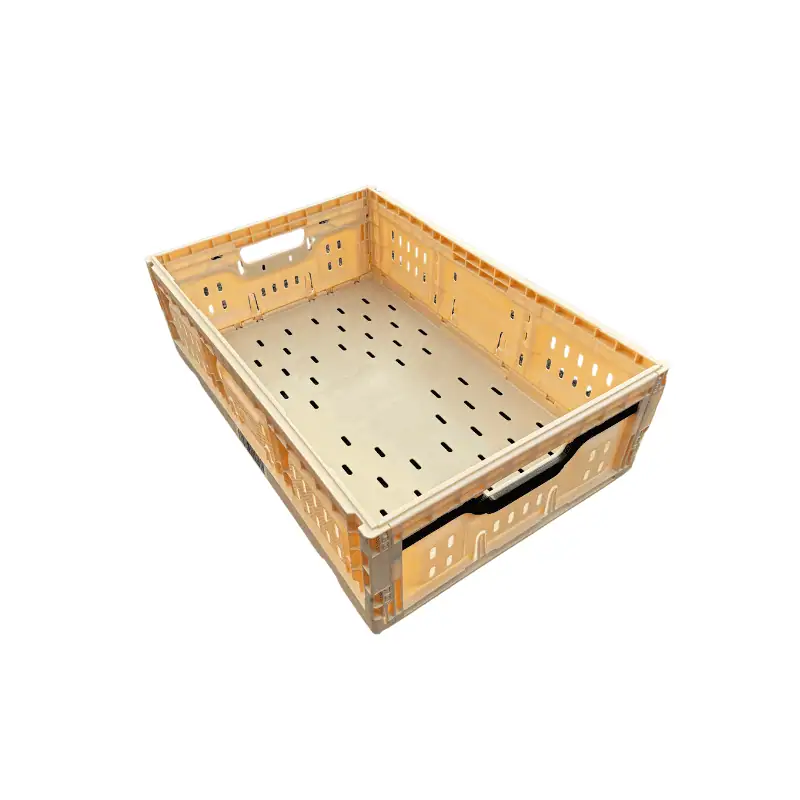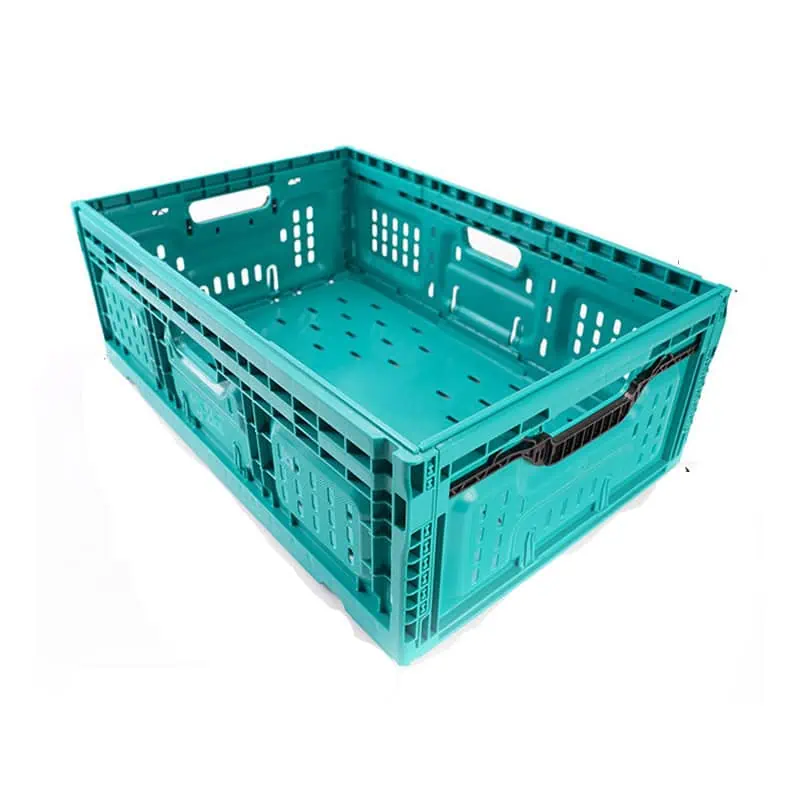
A mid-size fruit distributor from South America needed reusable plastic crates to ship different fruits varieties. Their requirements were clear: easy folding, high durability, excellent ventilation & drainage, secure stacking, very low folded height to reduce return-trip volume, and ability to withstand high-temperature washing.
We recommended our CZB series foldable crates in three heights — 600×400×120 mm, 600×400×180 mm, and 600×400×220 mm — and the result was improved handling, easier sanitation, and substantial savings on return logistics.
The customer’s pain points:
Folding mechanism: Press the side handle — crate collapses quickly and reliably.
Folded height: 35 mm — exceptionally low.
Stacking: Full crates can be stacked up to 10 layers safely (when used per load-limit guidance).
Material & durability: Industrial-grade, food-safe PP — impact resistant, suitable for repeated use.
Ventilation & drainage: Mesh/vent design allows airflow for freshness and rapid drainage after washing.
Sanitation: Rated to be washed at 80°C; material and design tolerate hot-water sanitation protocols without deformation.
To reduce bruising and maximize load efficiency, we recommended the following typical pairings:
600×400×120 mm (shallow): Soft or delicate fruits — e.g., strawberries, cherries, raspberries. Shallow height minimizes shifting and stacking pressure.
600×400×180 mm (medium): Mid-sized fruit — e.g., apples, pears, peaches. Good airflow with moderate depth.
600×400×220 mm (deep): Larger or bulkier fruit — e.g., oranges, mangoes — provides extra headroom and stacking safety.
The most significant impact was felt on the return journey. By reducing the height of an empty crate to just 35mm, we unlocked massive space savings compared to traditional rigid crates.
120mm Crate: Saves 70.8% of space when folded.
180mm Crate: Saves 80.6% of space when folded.
220mm Crate: Saves 84.1% of space when folded.
The Bottom Line: On a return trip, a single truck can now carry what used to require four or five. This doesn’t just cut fuel costs; it dramatically shrinks the company’s carbon footprint.

A key commercial advantage of the CZB crates is the folded height of 35 mm, which dramatically reduces empty return volume. Below are the space-saving calculations versus full crate heights (digit-by-digit):
600×400×120 mm
Folded height = 35 mm
Full height = 120 mm
Space saved when folded = (1 − 35 / 120) × 100% = 70.8% saved
600×400×180 mm
Folded height = 35 mm
Full height = 180 mm
Space saved = (1 − 35 / 180) × 100% = 80.6% saved
600×400×220 mm
Folded height = 35 mm
Full height = 220 mm
Space saved = (1 − 35 / 220) × 100% = 84.1% saved
Interpretation: depending on the crate model, a single folded CZB crate occupies only ~15–29% of its original volume — typically reducing return-trip payload volume by 70–84% per crate. That directly cuts the number of trucks/containers needed for returns, lowering transport costs and CO₂ footprint.
After switching to CZB crates, the customer reported the following operational improvements:
Fewer return trips / smaller return payloads due to dramatic folded-volume savings (see calculations above).
Simpler handling: crates collapse with one press on the side handle; warehouse staff found packing and storing empties faster.
Improved product ventilation: the ventilated design reduced condensation and helped preserve fruit quality during short transit windows.
Faster sanitation cycles: crates withstand 80°C hot-water washing; the mesh drains quickly and leaves minimal residual water, reducing drying time before reuse.
High stacking efficiency: stable stacking (up to 10 layers) saved vertical pallet space for loaded crates.
To keep crates hygienic for fresh produce:
Pre-rinse loose debris with cold water.
Hot wash at up to 80°C (pressure washer or industrial washer) to remove residues and sanitize.
Rinse briefly; the crate mesh promotes fast drainage — water exits through the vents quickly.
Air dry or use forced-air drying if needed; minimal retained water reduces drying time.
Inspect for damage or residue; CZB crates are designed for repeated cycles but should be retired from food use when structural defects appear.
Note: Always follow your local food-safety guidelines and, if required, use approved disinfectants compatible with the crate material.
When loading full crates, do not exceed the rated stack/load limits — CZB crates support safe stacking up to 10 layers but follow load recommendations per product density.
When folding, ensure lids/sides are clear of produce and workers keep fingers clear of hinges. The side-handle folding action is simple and fast.
Labeling: use barcode or RFID labels on the short side for fast scanning on conveyors and in sorting lines.

Reduced return trip volume translates directly into fewer trucks or less pallet space on return legs — significant for cross-continent exporters.
Durability & reusability lower the frequency of replacements compared with single-use cardboard.
Lower produce loss thanks to better ventilation and stable stacking.
Lower labor & handling time because folding and stacking are simple and uniform.
The CZB foldable crate series delivers a practical, robust solution for fresh-produce shippers who need space-saving returns, durable handling, excellent ventilation, and hot-water sanitation compatibility. For multi-product operations, offering the three heights (120 / 180 / 220 mm) ensures the right crate for each fruit type — improving product protection, operational efficiency, and logistics cost control.
If you’d like a cost estimate, container-loading calculation, or a sample pack with all three CZB sizes, contact our sales team. Learn more about our collapsible crates.